

By Jatin Singh | October 30, 2025
In the icy waters of the Arctic, the bowhead whale glides silently beneath sheets of ice, defying time itself. These majestic giants, capable of living more than 200 years, have puzzled scientists for decades. How does a creature with billions of cells, a massive body, and a long lifespan avoid the curse of cancer and aging that strikes so many other mammals?
A new study published in Nature may finally hold the key. Researchers have discovered that bowhead whales possess a suite of enhanced DNA repair mechanisms that protect their cells from the relentless damage that accumulates with age. These findings could reshape our understanding of biological aging — and may even open doors to future breakthroughs in human longevity and cancer prevention.
The Paradox of the Giant
In evolutionary biology, there exists a long-standing puzzle known as Peto’s Paradox. It questions why large animals like whales or elephants, which have far more cells than smaller creatures, do not have proportionally higher cancer rates.
Each additional cell theoretically increases the chance of mutations that can lead to cancer. Yet whales and elephants seem to have evolved robust ways to suppress these risks.
The bowhead whale, Balaena mysticetus, stands as one of the most striking examples of this paradox. With a lifespan that can exceed two centuries — more than twice that of humans — and a body mass up to 100 tons, it should statistically be far more prone to cancer. Instead, it remains remarkably resilient.
The new study by an international team of geneticists and marine biologists reveals that nature has quietly built an anti-aging laboratory beneath the Arctic Ocean.
Cracking the Genetic Code of Longevity
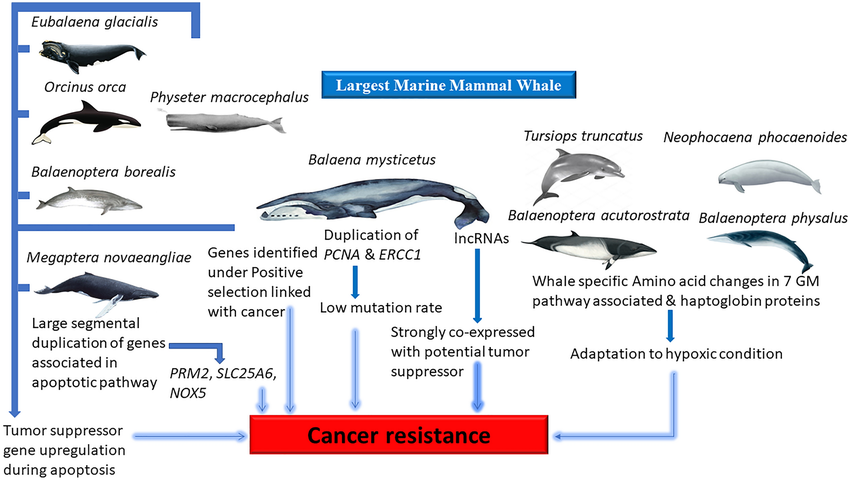
The research team sequenced and compared the genomes of bowhead whales with those of shorter-lived mammals, such as humans, mice, and other whale species. What they found was astonishing: the bowhead whale’s DNA harbors unique mutations and amplifications in genes responsible for DNA repair, cell cycle regulation, and tumor suppression.
One gene, in particular — ERCC1, known for its role in excising damaged DNA segments — appears to be far more active in bowhead whales. Enhanced expression of ERCC1 enables their cells to efficiently repair double-strand breaks and oxidative DNA damage, preventing mutations from accumulating over time.
Another standout finding involves PCNA (Proliferating Cell Nuclear Antigen), a protein that coordinates DNA replication and repair. In bowheads, PCNA shows specialized amino acid changes that boost its stability and efficiency. This allows for continuous, high-fidelity DNA repair even in older cells.
The study also identified duplicated copies of TP53, the famous “guardian of the genome” — a tumor suppressor gene that detects DNA damage and halts cell division before mutations can spread. While humans carry a single copy of TP53, bowhead whales appear to have evolved multiple functional variants, further strengthening their cancer defenses.
How DNA Repair Protects Against Aging
Every second, the DNA in living cells faces attacks from radiation, toxins, and metabolic processes. In humans, unrepaired DNA damage contributes to aging, chronic disease, and cancer.
But in bowhead whales, enhanced repair systems act like an internal maintenance crew, constantly fixing genetic wear and tear.
According to Dr. Elina Andersson, a molecular biologist involved in the study, “The bowhead genome shows an extraordinary commitment to preservation. Its cells can repair DNA damage at a rate unmatched by any known mammal. It’s as if evolution engineered a perfect molecular caretaker.”
The research team tested whale-derived cell cultures in the lab, exposing them to oxidative stress and radiation. While human cells showed rapid damage accumulation and death, bowhead cells remained stable and functional far longer. Their ability to maintain protein homeostasis — preventing the buildup of toxic misfolded proteins — further contributes to tissue health and longevity.
More Than Just Good Genes
Genetics is only part of the story. The bowhead whale’s unique physiology and slow metabolism may also play critical roles in its extended lifespan.
Living in frigid Arctic waters, bowheads have a low body temperature and slow metabolic rate, producing fewer reactive oxygen species — the molecules responsible for cellular aging. Their tissues also contain specialized anti-inflammatory molecules and lipids that reduce oxidative stress.
Moreover, bowheads have evolved exceptional immune system regulation. Instead of chronic inflammation — a hallmark of aging in humans — their immune response remains balanced and efficient even in old age.
Dr. Andersson explains, “We often think of longevity as genetic, but the whale reminds us that environment and metabolism also shape life span. Its entire biology seems tuned toward maintenance rather than growth.”
Implications for Human Health and Aging
The bowhead whale’s molecular secrets are more than a scientific curiosity — they may hold clues to extending human life. Researchers are now exploring whether similar genetic mechanisms could be replicated or mimicked in people.
If scientists can understand how whales maintain genomic stability over centuries, it could inspire new anti-aging therapies aimed at repairing DNA damage, improving cellular resilience, and preventing age-related diseases like cancer, Alzheimer’s, and cardiovascular disorders.
Already, biotechnology companies and longevity researchers are studying whale-derived proteins to identify molecules that can enhance DNA repair pathways in human cells. Some of these could form the basis for future drugs designed to slow biological aging or increase healthy lifespan.
“Imagine a medicine that helps your body fix its DNA like a whale does,” says Dr. Andersson. “That’s no longer science fiction. It’s a logical next step in translational genomics.”
Why Bowhead Whales Are a Conservation Priority
Beyond their biological marvels, bowhead whales are also an endangered species. They inhabit some of the most remote and fragile ecosystems on Earth, from the Bering Sea to the Beaufort Sea.
Climate change, melting ice, and industrial noise pollution threaten their food sources and migratory patterns.
Conservationists warn that losing these ancient beings would mean erasing a living archive of evolutionary medicine. Protecting bowhead whales, therefore, is not just about saving a species — it’s about preserving nature’s blueprint for long life.
Dr. Maria López, a marine ecologist who has studied Arctic mammals for two decades, calls them “the guardians of time.”
“When we protect bowheads, we protect a biological miracle — a species that has already solved problems human medicine is still struggling to understand.”
A New Era of Comparative Longevity Science
The whale study is part of a broader scientific movement exploring how long-lived species — from naked mole rats to giant tortoises — resist aging and disease. By comparing genomes across these creatures, scientists are uncovering patterns of natural longevity evolution.
For instance, elephants have multiple copies of the TP53 gene, similar to whales. Naked mole rats produce high levels of a protective sugar polymer called hyaluronan that prevents cancer. Tortoises have exceptional DNA repair enzymes that prevent telomere shortening — a key marker of cellular aging.
Each species offers a piece of the puzzle, but bowhead whales may represent the pinnacle of mammalian longevity. Their genetic adaptations provide one of the clearest examples yet that evolution can engineer extraordinary lifespans without sacrificing health or fertility.
The Ocean’s Timeless Teacher
The discovery of enhanced DNA repair in bowhead whales forces us to rethink what it means to age.
For centuries, humans have sought elixirs of youth, miracle diets, and anti-aging supplements. Yet perhaps the true answer has been swimming quietly beneath Arctic ice all along — a living example of molecular balance and biological harmony.
As scientists continue to decode its genome, the bowhead whale may teach us the most profound lesson of all: that longevity is not about defying time, but mastering repair.
Conclusion
From the vast depths of the Arctic Ocean comes a revelation that could reshape modern medicine. The bowhead whale’s powerful DNA repair systems, enhanced tumor suppressor genes, and resilient cellular machinery stand as a testament to evolution’s genius.
While humans may never live for 200 years, understanding how whales do could inspire revolutionary approaches to aging, disease prevention, and regenerative health.
In a world obsessed with extending life, the bowhead whale reminds us that longevity isn’t magic — it’s maintenance, perfected over millions of years.