
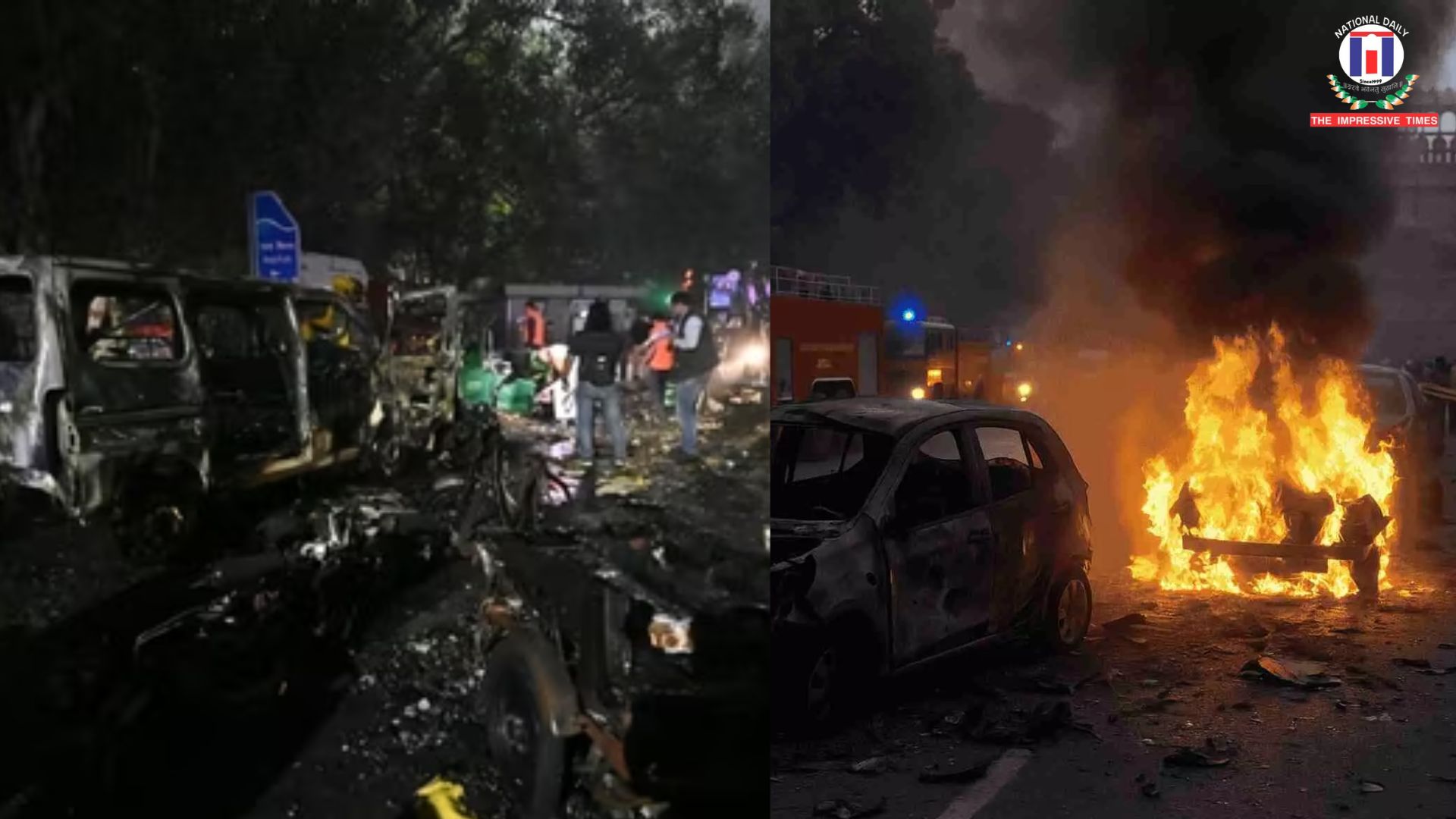

New Delhi | November 10, 2025 — A massive car explosion near the Red Fort Metro Station on Monday evening has sent shockwaves across the national capital. The blast, which occurred near Gate No. 1 of the Red Fort Metro Station, triggered a fire that engulfed several nearby vehicles and left multiple casualties. According to initial reports, at least eight people have died, and several others sustained serious injuries.
The incident has prompted a high alert across Delhi, with security tightened in all sensitive zones, particularly around heritage sites and metro networks. Investigations are currently underway to determine whether the explosion was caused by a CNG cylinder malfunction or an improvised explosive device (IED).
This is what we know so far about the tragic incident that has once again raised questions about urban safety and vehicular security in India’s capital.
The Incident: A Sudden Blast in the Heart of Delhi
Eyewitnesses describe the scene as “chaotic and terrifying.” Around 7:15 PM IST, a white hatchback parked near Red Fort Metro Station Gate No. 1 exploded, sending flames and thick black smoke billowing into the evening sky.
The blast occurred just a few hundred meters from the historic Red Fort monument, one of Delhi’s busiest tourist and commuter areas. At the time of the explosion, the area was crowded with commuters, vendors, and tourists, many of whom were leaving the metro station or visiting the nearby market.
The explosion’s impact was so strong that three adjacent cars and several two-wheelers caught fire. Witnesses reported hearing a loud bang followed by cries for help as bystanders rushed to rescue those trapped in vehicles.
“It felt like an earthquake — the ground shook, and a ball of fire rose into the sky,” said Rakesh Kumar, a local vendor who witnessed the blast.
“People started running in panic, and traffic came to a standstill.”
Casualties and Damage
According to official sources from the Delhi Fire Services (DFS) and Delhi Police, at least eight people have died, including two pedestrians who were passing by at the time.
Another 12 to 14 people have been hospitalized, with injuries ranging from burns to blast trauma. Several are being treated at Lok Nayak Hospital and LNJP Trauma Centre.
The blast also caused significant property damage:
- At least four cars were completely gutted.
- Three motorcycles and street kiosks nearby were destroyed.
- Windows of nearby shops and vehicles were shattered due to the impact wave.
“Our teams reached the site within minutes and brought the fire under control,” said Atul Garg, Chief of Delhi Fire Services.
“The situation is under control, and we are coordinating with the police for a detailed forensic investigation.”
Possible Cause: CNG Cylinder Blast or IED?
While an official cause is yet to be confirmed, authorities are exploring two primary possibilities:
1. CNG Cylinder Explosion (Accidental Cause)
The car in question was reportedly a CNG-fitted vehicle. Initial forensic assessments suggest that a leak or rupture in the CNG cylinder could have caused the explosion.
In India, CNG-powered vehicles are common due to environmental regulations, but poor maintenance or unauthorized installations can make them vulnerable to gas leaks and pressure-related failures.
“Preliminary signs indicate that the car may have been running on CNG, and a sudden pressure buildup could have caused the cylinder to burst,” a senior fire official told reporters.
If confirmed, this would mark yet another CNG-related accident in Delhi — a city that has seen multiple such incidents in recent years due to aging vehicles and lack of safety compliance.
2. Explosive Device (Suspicious Activity)
However, given the location’s sensitivity — near the Red Fort, a heritage and high-security zone — authorities are not ruling out the possibility of a deliberate act or sabotage.
Bomb disposal squads and forensic teams have been deployed to collect residue samples and examine the car’s remains. Experts from the National Security Guard (NSG) are assisting in the analysis.
“We are examining all angles, including the possibility of a low-intensity IED,” said Special Commissioner of Police (Law & Order) Deepak Yadav.
“It would be premature to draw conclusions without forensic confirmation.”
Rapid Emergency Response
Within minutes of the explosion, multiple fire tenders and rescue teams were dispatched to the scene.
- Five fire engines were deployed to douse the flames.
- Ambulances from LNJP and Safdarjung hospitals arrived to transport the injured.
- The Delhi Metro Rail Corporation (DMRC) temporarily suspended services at the Red Fort station, and entry/exit gates were sealed for safety.
Local residents and metro staff played a crucial role in helping victims before emergency personnel arrived. Videos circulating on social media show bystanders using water bottles and fire extinguishers to help control the flames.
“The response from nearby shopkeepers and commuters was immediate — they helped pull out people from burning cars,” said Priya Mehta, a journalist who reached the site shortly after the blast.
Security Measures: Delhi on High Alert
Following the explosion, the Delhi Police imposed a high alert across the city. Security has been strengthened at metro stations, government buildings, and tourist hotspots, including:
- India Gate
- Connaught Place
- Kashmere Gate and Chandni Chowk areas
- Airport and Railway terminals
The Delhi Metro Rail Corporation (DMRC) and Central Industrial Security Force (CISF) have also been instructed to increase surveillance, baggage screening, and patrols across stations.
Intelligence agencies have been roped in to verify if any terror-related inputs were received before the blast.
“It’s standard procedure to escalate alert levels in the aftermath of such incidents,” said DCP (North District) Manoj C, assuring that “there is no immediate threat perception to other parts of Delhi.”
Eyewitness Accounts Paint a Grim Picture
The chaos following the blast was captured by several onlookers who shared footage on social media. Videos show vehicles engulfed in flames and people running for cover as smoke spread across the area.
“I was waiting for a bus when I heard a loud bang — within seconds, flames were everywhere,” recalled Anjali Sharma, a college student.
“Two men came out of the burning car screaming for help before collapsing.”
Local residents also complained about delayed police arrival due to traffic congestion in the area, although emergency response teams arrived swiftly thereafter.
Public Safety Concerns: CNG Vehicles Under Scrutiny
If confirmed as a CNG blast, the incident could spark a major review of vehicle safety regulations in Delhi.
With over 1.3 million CNG-powered vehicles, the city has one of the highest concentrations of CNG usage in the world.
However, reports have repeatedly highlighted issues such as:
- Use of expired or uncertified cylinders.
- Unauthorized retrofitting by unlicensed mechanics.
- Poor enforcement of safety checks.
“Many drivers ignore cylinder inspections due to cost or negligence,” says Amit Tiwari, an automobile safety expert.
“Aging cylinders and loose fittings can turn vehicles into ticking time bombs.”
Authorities may now enforce stricter inspection protocols, particularly in high-traffic zones like metro stations and markets.
Heritage Zone Under Watch
The proximity of the blast site to the Red Fort, a UNESCO World Heritage Site, raises concerns about security preparedness in areas that attract large crowds daily.
The monument, which draws thousands of tourists and school groups, is already a high-security zone, especially after previous incidents like the 2000 Red Fort terrorist attack.
This explosion has led to renewed demands for:
- Banning CNG vehicles from parking near heritage sites.
- Increasing vehicle inspection stations near tourist areas.
- Deploying AI-powered surveillance cameras to monitor parked vehicles.
Investigation Updates
By late Monday night, multiple agencies had taken over the investigation:
- Delhi Police’s Special Cell is leading the primary investigation.
- Forensic Science Laboratory (FSL) teams are analyzing debris samples.
- NSG bomb disposal experts have examined fragments of the car for explosive residues.
- CCTV footage from metro station entrances and adjacent roads is being reviewed.
Authorities are also tracking the car’s ownership and registration details to identify the owner and any recent servicing or modifications.
“We have secured all CCTV footage and are questioning nearby vendors and metro staff,” confirmed Deputy Commissioner of Police (Central Zone).
“The results of forensic testing will determine our next course of action.”
Reactions from Authorities and Public Figures
Delhi Chief Minister Arvind Kejriwal expressed condolences to the victims and urged residents to remain calm while ensuring full cooperation with investigating teams.
“This is a tragic incident. The government stands with the families of those affected. All possible assistance and compensation will be provided,” said Kejriwal in a statement.
Union Home Minister Amit Shah has sought an immediate report from the Delhi Police Commissioner and directed central agencies to assist in the investigation.
Leaders across party lines called for enhanced urban safety audits, especially concerning CNG and LPG-fitted vehicles in public spaces.
Social Media Reactions and Public Sentiment
The incident quickly trended on X (formerly Twitter) under hashtags like #DelhiBlast and #RedFortExplosion, with thousands expressing shock and anger.
Many users demanded stricter checks on public parking zones near tourist areas, while others shared concerns about infrastructure safety and CNG system oversight.
“We need better CNG regulations — this is not the first time such an accident has happened,” one user tweeted.
“A city like Delhi deserves better safety infrastructure,” another commented.
Lessons and Safety Measures Moving Forward
The Red Fort car explosion underscores critical lessons for urban planners, authorities, and citizens alike:
1. Strengthening CNG Safety Regulations
- Mandatory annual inspection of all commercial and private CNG vehicles.
- Stricter penalties for unauthorized retrofitting.
2. Enhanced Surveillance in High-Risk Zones
- Installation of AI-based vehicle monitoring systems near metro stations.
- Restriction of parking within 200 meters of major monuments.
3. Public Awareness
- Citizens must be educated on early warning signs of CNG leaks, such as unusual odor or sound.
- Awareness drives for cab drivers and auto owners about regular maintenance.
4. Emergency Preparedness
- Conduct regular fire drills and explosion response simulations near crowded public hubs.
- Equip metro staff and vendors with fire extinguishers and basic first aid training.
Conclusion: A Wake-Up Call for Urban Safety
The car explosion near Red Fort Metro Station serves as a stark reminder of the fragility of safety in high-density urban environments.
Whether caused by a mechanical malfunction or deliberate act, the incident highlights the urgent need for stronger enforcement of CNG safety protocols, improved surveillance, and emergency response systems.
As investigations continue, Delhi must balance its rapid urban growth with robust safety measures — ensuring that incidents like this never recur in the heart of India’s capital.
“We can rebuild cars and roads,” said a local resident, “but we cannot rebuild lives. Let this be a turning point for how we prioritize safety in our cities.”