
Russia launches one of the largest drone and missile attacks on Ukraine, striking energy and civilian infrastructure across Kyiv, Lviv, and Dnipro. Massive power outages and humanitarian crises reported.
🌍 Introduction: One of the Largest Russian Attacks Since the War Began
In a devastating escalation of the ongoing conflict, Russia launched one of its largest drone and missile attacks on Ukraine this week, targeting critical energy and civilian infrastructure across multiple regions, including the capital city, Kyiv.
According to Ukrainian authorities, the overnight barrage involved over 450 drones and 45 long-range missiles, marking one of the most intense assaults since Russia’s full-scale invasion in 2022. The strikes caused massive power outages, crippled parts of Ukraine’s grid, and disrupted essential services in several major cities.
President Volodymyr Zelenskyy condemned the attack, calling it “a deliberate act of terror designed to freeze and frighten the Ukrainian people” as the nation braces for a harsh winter.
🚀 Details of the Attack: A Night of Relentless Bombardment
🕛 The Assault Timeline
The attacks reportedly began late Thursday night and continued into early Friday morning, hitting Kyiv, Lviv, Dnipro, Zaporizhzhia, and Kharkiv almost simultaneously. Ukrainian air defense systems were activated across the country in what officials described as “a continuous night of explosions.”
- 450+ Shahed-type drones (Iranian-designed UAVs used extensively by Russia) were launched in waves.
- 45 cruise and ballistic missiles targeted power plants, substations, and other infrastructure.
- Dozens of intercepts were reported, with Ukraine’s Air Force claiming to have shot down more than 80% of incoming drones.
Despite the strong defense, several key facilities were hit, leading to widespread blackouts and fires in multiple regions.
⚡ Kyiv and Major Cities Plunged Into Darkness
The capital city, Kyiv, bore the brunt of the attack. Local authorities confirmed that at least 30% of the city’s power supply was disrupted, affecting public transportation, hospitals, and emergency services.
Residents reported explosions throughout the night, followed by power cuts, water shortages, and mobile network failures.
“It was like the entire city was under siege. We heard drones overhead all night,” said Oksana, a Kyiv resident, speaking to Reuters.
In Lviv, a cultural hub in western Ukraine, critical energy facilities were destroyed, cutting off electricity to nearly half the population. Dnipro and Zaporizhzhia, both near the front lines, also suffered heavy damage.
The Ukrainian national energy company Ukrenergo stated that “generation capacity has dropped to critical levels,” warning of rolling blackouts across the nation for at least the next several days.
💣 Russia’s Objective: Crippling Ukraine’s Energy Grid
Military analysts believe that Russia’s primary goal was to cripple Ukraine’s energy infrastructure ahead of winter, mirroring similar strategies used during the 2022–2023 campaign.
By targeting the power grid, thermal plants, and fuel depots, Russia aims to undermine Ukraine’s civilian morale and logistical capabilities.
According to Ukraine’s Defense Ministry, this attack follows a clear pattern:
- Striking energy sites in colder months to maximize hardship.
- Testing and exhausting Ukraine’s limited air-defense systems.
- Pressuring international allies to reconsider ongoing military aid.
“This was not a random strike. It was a coordinated attempt to paralyze our country’s lifeline,” said Andriy Yermak, chief of staff to President Zelenskyy.
🔥 Humanitarian Impact: Millions at Risk as Winter Nears
With temperatures dropping and power grids failing, millions of Ukrainians now face freezing conditions, particularly in the country’s northern and eastern regions.
- Hospitals are operating on backup generators.
- Water supply systems in several cities have stopped functioning.
- Schools and public buildings have been converted into heating shelters.
International humanitarian agencies, including the Red Cross and UNHCR, have begun mobilizing emergency aid such as power generators, thermal blankets, and food packages.
The Ukrainian Health Ministry also warned that the energy collapse could hinder critical medical services, especially for the elderly and chronically ill.
“The humanitarian toll of these attacks will be immense if energy is not restored soon,” said a UN relief official based in Lviv.
🕊️ Civilian Casualties and Destruction
Early reports indicate that at least 37 people have been killed and over 150 injured across different regions, though officials caution that the numbers may rise as rescue operations continue.
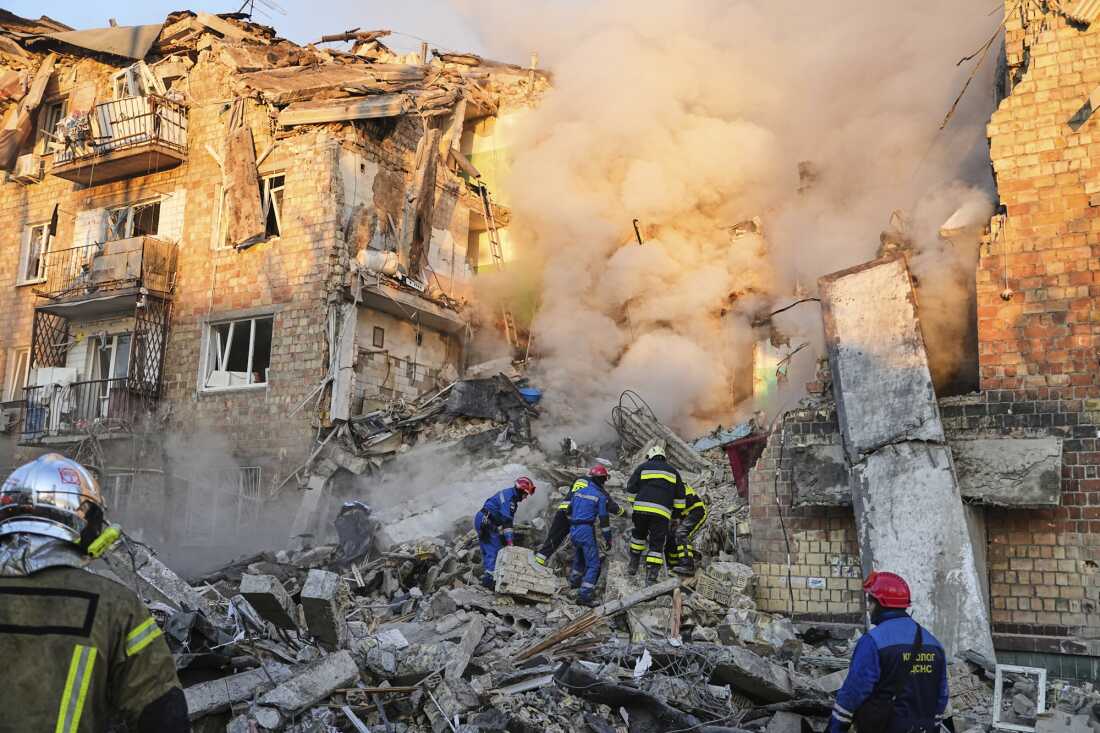
In Dnipro, a missile struck a residential apartment block, killing several families. In Kyiv, a drone hit a transformer substation, sparking massive fires that took firefighters several hours to contain.
Images shared by Ukrainian emergency services show collapsed buildings, charred vehicles, and debris-strewn streets. Thousands of residents have been evacuated from affected areas.
“Every time the lights go out, we feel like we are going back to the darkest days of the war,” said Mykola, a resident of Kharkiv, speaking to local media.
⚔️ Ukraine’s Response: Strength and Defiance
Despite the damage, Ukraine continues to show resilience.
President Zelenskyy addressed the nation, vowing that Russia’s terror campaign would not break Ukrainian spirit.
“They can destroy our power plants, but they cannot destroy our will to fight,” Zelenskyy declared in a televised address.
The Ukrainian Air Force claimed to have successfully intercepted 38 of 45 missiles and 350 out of 450 drones, a significant defensive feat considering the scale of the attack.
Ukraine’s military intelligence agency, GUR, said the strikes were coordinated from multiple Russian bases, including Crimea, Kursk, and the Black Sea Fleet.
🌐 International Reaction: Global Condemnation
The global community swiftly condemned the attack, calling it a violation of international humanitarian law.
- The European Union labeled the strikes as “a deliberate targeting of civilians,” promising new sanctions on Russian defense suppliers.
- The United States pledged additional air defense support, including Patriot systems and NASAMS interceptors, to help Ukraine defend its skies.
- The United Nations Security Council held an emergency meeting to discuss the escalation, though Russia blocked a resolution condemning its actions.
NATO Secretary-General Jens Stoltenberg said the attack “underscores the need for continued support to Ukraine’s defense and resilience.”
Meanwhile, Moscow’s Defense Ministry claimed responsibility for the attack, calling it a “precision strike on military and energy targets.” However, satellite imagery and local reports show significant civilian infrastructure damage, contradicting Russia’s statement.
⚙️ The Broader Context: A War Entering a New Phase
This large-scale attack comes amid stalled peace talks and heightened tensions on the front lines. Analysts suggest that Russia may be trying to:
- Undermine Ukrainian morale before the winter campaign.
- Divert attention from domestic instability within Russia.
- Pressure Western nations into negotiating under humanitarian pretexts.
At the same time, Ukraine is ramping up its drone counteroffensive, targeting Russian oil depots and military bases deep inside Russian territory. This tit-for-tat dynamic has pushed the war into a technologically intensive phase dominated by drones, AI-guided weapons, and cyber warfare.
🔋 Ukraine’s Energy Future: Rebuilding Amid Ruins
Ukraine’s energy minister, German Galushchenko, announced emergency repair efforts but warned that complete restoration could take weeks.
The government is prioritizing critical infrastructure such as hospitals, shelters, and military command centers. Citizens have been urged to conserve electricity and prepare for rolling blackouts.
International partners, including the EU, USA, and Japan, are expected to send mobile power units and replacement transformers under the Energy Support Fund for Ukraine.
Despite the dire situation, Ukraine has vowed to rebuild its power grid stronger than before, investing in renewable and decentralized energy systems to reduce future vulnerability.
📢 Conclusion: Defiance in the Dark
The latest wave of drone and missile strikes represents a grim reminder of the war’s enduring brutality. Yet, amid destruction and darkness, Ukraine’s resilience shines brighter than ever.
As Kyiv and other cities struggle to restore power and safety, the nation remains steadfast — determined not just to survive, but to endure, rebuild, and eventually prevail.
“We have lived without light before. We can live without it again. But we will never live without freedom,” said one Kyiv resident, summing up the spirit of a nation that refuses to surrender.